

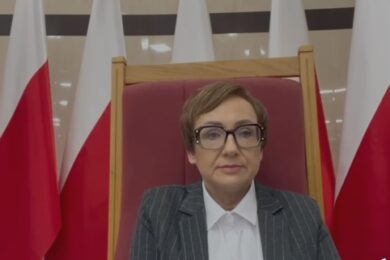


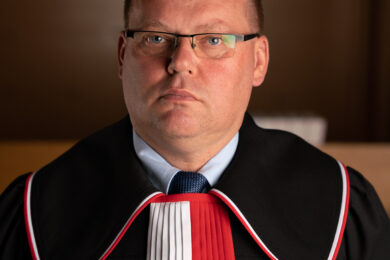

In his statement issued following the nighttime incidents at the Constitutional Tribunal, Karol Nawrocki omits a fundamental fact: he himself decided to go to the Tribunal’s headquarters in the middle of the night, initiating a direct confrontation at the entrance to the building. During that confrontation, pushing and shoving occurred involving individuals elected as judges of the Constitutional Tribunal, whose judicial status he then arbitrarily denied.
The President cannot arrogate to himself the authority to determine who is a lawfully appointed judge of the Tribunal, nor can he seek to impose his own interpretation of the law through personal intervention at the headquarters of an independent constitutional body.
Exceeding the Limits of Constitutional Authority
Article 173 of the Polish Constitution guarantees the separation and independence of courts and tribunals from other branches of government. Article 126(3) expressly limits the exercise of presidential duties to the scope and principles established by the Constitution and statutes. Article 7, in turn, requires all public authorities to act on the basis of and within the limits of the law.
The President has no authority over the Constitutional Tribunal, does not supervise its activities, and has no power to independently resolve disputes concerning the Tribunal’s leadership. Still less can he arbitrarily decide who may perform official functions within that institution.
Particularly revealing is his statement that he personally enabled the Vice President of the Constitutional Tribunal to enter the building. On what legal basis does the President claim the authority to decide whether individuals holding office within the Tribunal may enter its headquarters?
Wrongfully Attributing the Actions of Separate State Authorities and Officials to the Government
Particularly serious concerns arise from the passage in which the President calls for the withdrawal of the „coercive forces sent to the scene by the government” from the Tribunal’s premises. This wording reveals a failure to understand fundamental constitutional principles and obscures the legal distinctions between the powers of individual state authorities.
The actions in question were undertaken by separate actors: a Constitutional Tribunal judge enjoying the constitutional guarantee of judicial independence, the Prosecutor General exercising his own statutory powers, and the police carrying out their duties to protect public safety and order. The fact that the police form part of the government administration, while the Minister of Justice also holds the office of Prosecutor General, does not automatically justify attributing all these actions to the government as a coordinated political operation. Still less does it justify attributing the actions of an independent Constitutional Tribunal judge to the government.
The official police statement of October 30, 2026, confirms that the officers acted after receiving separate requests from the Prosecutor General and a Constitutional Tribunal judge. The police conducted no operations inside the Tribunal building or against the Tribunal Guard. Their activities were confined to the area outside the building and to ensuring public safety.
Portraying these actions as a forcible takeover of a constitutional institution finds no support in the official findings of the police.
The President thus portrays the exercise of separate statutory powers as alleged government interference with the Tribunal’s independence, disregarding the fundamental principles governing the organization and functioning of the state.
Moreover, his call for the police to withdraw from the Tribunal’s premises has no binding legal effect. Under Article 5(1) of the Police Act, the Commander-in-Chief of the Police is subordinate to the minister responsible for internal affairs, not to the President of the Republic of Poland. The President has no authority to issue operational orders to the police or to direct them to cease performing their statutory duties.
The President’s public appeal is therefore political rather than legally binding. It provides no legal basis for withdrawing police officers, and failure to comply with it does not constitute a violation of the law. The President may issue appeals, but he cannot thereby create powers that neither the Constitution nor statutes confer upon him.
The First President of the Supreme Court and Judicial Independence
Serious concerns also arise from the personal involvement of the First President of the Supreme Court, Zbigniew Kapiński, in the nighttime incidents at the Constitutional Tribunal, as well as the President of the Republic’s reliance on Kapiński’s position as confirmation of his own interpretation of the law.
The First President of the Supreme Court is not an authority superior to the Constitutional Tribunal, has no power to determine the legality of its composition, and cannot confer legal legitimacy on the President’s intervention.
The situation is all the more problematic because the lawfulness of Kapiński’s own appointment as First President of the Supreme Court is subject to objections analogous to those concerning Bogdan Święczkowski’s appointment as President of the Constitutional Tribunal. In both cases, the objections concern the participation of individuals whose judicial status is disputed in the procedures for selecting candidates for these positions.
Under these circumstances, particular restraint in making categorical judgments about the legality of appointments to another constitutional institution would seem to be an elementary requirement. Instead, Kapiński’s personal involvement in the President’s actions raises further questions about respect for judicial independence, impartiality, and the institutional separation of the judiciary.
Convening Consultations Does Not Confer New Powers
The President may hold political consultations with representatives of parliamentary parties. However, no such consultations authorize him to assume the powers of the Constitutional Tribunal, resolve disputes concerning the status of judges, or replace procedures established by law.
A political initiative undertaken by the President cannot be equated with a legally binding determination. Nor does invoking a threat to the state’s internal security expand his constitutional powers.
Judyta Papp
