


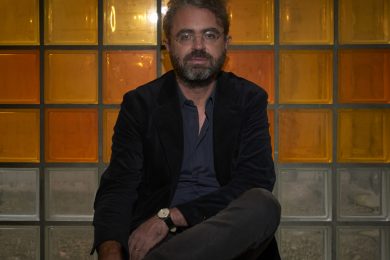


Maximilian Steinbeis, założyciel i wieloletni redaktor renomowanego poświęconego prawu konstytucyjnemu blogu Verfassungsblog.de został niedawno uhonorowany tytułem doctora honoris causa uniwersytetu w Münster. Poniższy tekst oparty jest na przemówieniu, które wygłosił w ramach podziękowań 1 lipca 2025 r.
Maximilian Steinbeis, po ukończeniu na początku lat 90. studiów prawniczych rozpoczął, w połowie lat dziewięćdziesiątych studia doktoranckie w Monachium pod kierunkiem Petera Landaua na temat „koncepcji idei prawa”.
Przez jakiś czas próbowałem zainteresować się twórczością Rudolfa Stammlera i Hermanna Cohena, […]. Na szczęście wcześnie zdałem sobie sprawę, że nigdy nie uda mi się napisać na ten temat niczego, co usprawiedliwiałoby poświęcenie trzech do pięciu lat mojego życia, ani że więcej niż cztery osoby w ogóle to zauważą – nie mówiąc już o przeczytaniu. Zrezygnowałam więc ze ścieżki akademickiej i zwróciłam się w stronę dziennikarstwa, które przecież też polega na odkrywaniu ciekawych prawd i pisaniu o nich.
Wtedy to zatrudnił się – na kilkanaście lat – w renomowanym dzienniku gospodarczym Handelsblatt.
Zostałem dziennikarzem. Nie byłem już uczonym, ale nadal chciałem wiedzieć to, co wiedzą uczeni. Pomyślałem więc: po prostu ich zapytam. W ten sposób zajmowałem się głównie dziennikarstwem – dzwoniłem do profesorów prawa. Prawie zawsze mieli coś wartościowego do powiedzenia.
W końcu opuściłem Handelsblatt i założyłem Verfassungsblog. Kierowałem się tą samą logiką: Drodzy profesorowie prawa, to, co wiecie, ma najwyższe znaczenie publiczne, więc proszę, zapiszcie to.
A oto cała publikacja Maximiliana Steinbeinsa, którą udostępniamy w wersji oryginalnej – po angielsku.
The Public in Public Law
Post-Constitutional Depression and How to Overcome It
Last week, I had the honour of being awarded an honorary doctorate in law by the Faculty of Law at the University of Münster. I was absolutely delighted – not only, but also, because it’s actually the first academic degree I’ve ever received. I belong to a generation of law students who completed their studies with a Staatsexamen in the most literal sense: it was the Free State of Bavaria, not the Ludwig Maximilian University of Munich, that certified I had successfully studied law. The last academic statement made about me and my academic achievements – if memory serves – was my final criminal law certificate.
In the mid-1990s, I began a doctorate in Munich under Peter Landau on “the concept of the idea of law”. For a while, I tried to engage with the works of Rudolf Stammler and Hermann Cohen – but I soon realised that I couldn’t care less. Thankfully, I recognised early on that I would never manage to write anything on the topic that justified sacrificing three to five years of my life, or that more than four people would even notice – let alone read. So, I gave up my academic path and turned to journalism, which, after all, is also about discovering interesting truths and writing about them.
But I didn’t cut ties with legal scholarship – particularly public law. I had just started as a junior editor at Handelsblatt when Paul Kirchhof’s seat at the Federal Constitutional Court was about to become vacant and to be filled by a certain Udo Di Fabio. That was a big story for Handelsblatt, where Kirchhof enjoyed enormous respect – even in a newsroom otherwise far more interested in politicians and CEOs. So, who was this man stepping into his shoes? I rang up some old friends from Munich who had stayed in academia and asked them to tell me.
I was a political journalist, reporting on politics and policy – but what really fascinated me was polity: the res publica, what constitutes it, what sustains it democratically. My view was that legal scholars working in public law are to the democratic republic what engineers are to a machine: they are the ones who calculate, design, and operate the institutions of democracy – the constitutive rules that make political behaviour predictable, give the system durability and stability, and keep the space of collective decision-making open and diverse. That is knowledge that belongs in the public domain. It’s essential for understanding how things work – and why they do at all.
I had become a journalist. I was no longer a scholar – but I still wanted to know what scholars knew. So, I figured: I’ll just ask them. That’s how I did much of my journalism – calling up law professors. They almost always had something valuable to say.
Eventually, I left Handelsblatt and founded Verfassungsblog. And I followed the same logic: Dear law professors, what you know is of the highest public relevance, so please write it down. Make it accessible. Open it to the public. And use this handy little blog I’ve just set up to do it.
Around the time I launched Verfassungsblog in 2009/2010, the warning signs had already started to accumulate – indications that something was beginning to shift and crumble in this idea of legal scholarship as the engineering of democracy. The post-9/11 decade was just coming to a close: the era of “Rettungsfolter” (rescue torture), of „Bürgeropfer” (civic sacrifice), of “Feindstrafrecht” (enemy criminal law) – much of it presented to and through a fascinated public by scholars of public law.
Then came the financial crisis. Tensions between the European Court of Justice and the Federal Constitutional Court escalated. The euro and sovereign debt crises unfolded – and suddenly, Constitutional Court rulings, informed and inspired by academia, teemed with terms like sovereignty and identity. And in the wake of the financial crisis, seemingly distant in so-called Eastern Europe, Viktor Orbán returned to power. Thanks to peculiarities in Hungarian constitutional law, he secured a two-thirds parliamentary majority – and with it, not just the power but the legal authority to use democratic institutions, including the constitution, to dismantle democracy itself and establish a regime that can no longer realistically be removed through democratic means. And it was Orbán who then triggered what became known in Germany as the “refugee crisis” – Angela Merkel’s alleged border opening and the myth of the “rule of lawlessness”, a narrative significantly shaped and spread by legal scholars – despite the fact that anyone with even a basic understanding of European migration law could see it was utter humbug from the outset.
Constitutional law is constitutional politics, and constitutional politics is politics. It’s where concepts of power are crafted, articulated, and enforced. And legal scholarship is deeply embedded in that process. As I came to see more clearly, it always had been. Even back in the 1990s, while I was still studying law, and the much-revered Paul Kirchhof was drafting the Maastricht ruling at the Federal Constitutional Court – striking down tax laws and shielding the inherited wealth of the West German bourgeoisie from being used to finance the costs of reunification.
That all feels like a long time ago. And in hindsight, compared to what we are witnessing today, it seems almost idyllic. Like the first gusts of wind before the real storm hits – so mild, you barely remember them when the catastrophe is in full force. But we should be wary of natural metaphors. This is all man-made.
The catastrophe is here. And it’s happening so rapidly, so comprehensively, so fundamentally, that it’s hard to process even with all the signs and warnings we had. International law, the prohibition of war, of genocide, of crimes against humanity, the international criminal justice system – these things are not just being broken, as law always is. They are being treated as irrelevant. Also, and especially in Germany. For the federal government and much of the public discourse, international law no longer seems to function as a normative constraint – not when it clashes with what is now openly called Staatsräson. No one seems to even bother.
In the United States, the world’s oldest democratic constitutional state, the birthplace of the idea of a democratic republic held together by constitutive rules, from which every modern democracy (even France) has drawn essential inspiration for the past 250 years – what’s falling apart is beyond comprehension. It defies the frameworks of modern political and constitutional theory. What sense can we make of Elon Musk’s campaign of destruction through all sorts of public agencies? What logic explains the mass and ongoing disappearing of people by figures indistinguishable from masked thugs, and meant to be?
How can it be that the Supreme Court grants a government request to overturn a federal court injunction – an injunction the government had openly and blatantly ignored – in a case involving six individuals being deported to South Sudan, and likely death, simply because the government could? How can the Supreme Court not only grant such a request but do it without a single word of justification or explanation? What must that court tell itself about its own role in the American constitutional order?
Honestly, I have no idea. Nor do the American constitutional lawyers I’ve spoken with since. It’s incomprehensible.
Perhaps it’s not just liberal democracy, as we’ve taken it for granted since 1945, that is collapsing or being dismantled. Perhaps what’s disintegrating is the very idea of rational, bureaucratic governance: the system of agencies, responsibilities, experts, files, and hierarchies we’ve come to understand, through Max Weber, as the foundation and precondition of the modern state. It almost seems, to borrow a thought from Tine Stein, as though a new form of neo-patrimonial rule is returning to the stage: neo-feudal billionaire fiefdoms founded on personal loyalty and bonds of allegiance, providing for their clients, servants, and dependents, and receiving the same in return. Engaged in mutual raids and plunder, and scorning any rationale for legitimate rule – let alone republican liberty and equality.
Perhaps the modern state, built on exploitable land and fossil fuels, is simply running out of steam.
If that’s the case – what does that mean for public law scholarship and for the public that engages with it?
The obvious answer is: depression. You carry on, as far as you make it out of bed, studying and teaching the usual subjects, lamenting the state of the world, and hoping that somehow it will all keep going. What else can you do? What can we even teach students in international law today about the world out there? I’ve heard of some U.S. professors who have simply stopped teaching American constitutional law because what they teach no longer reflects reality. In German public law, at least, there’s still the comforting belief that all of this is far away, that things are different here and will, hopefully, remain someone else’s problem.
I’d suggest looking for less obvious answers. For answers that might lie beyond modern constitutional and bureaucratic rationality. For ways to open and preserve spaces of liberty and equality that the state may not need to guarantee as necessarily as we’ve come to assume over the last two and a half centuries. Spaces of autonomy and self-governance.
The university, for example. Do we really have to conceive of it as a part of the state higher education administration, as we currently do? Where the university president receives instructions from the government on how to handle protesting students? Where armed police, guarding university buildings, don’t even have to explain themselves to the president, who asks them to leave? What would a truly autonomous, free university look like? One in which members collectively guarantee one another academic freedom? And isn’t there something within the German Basic Law, within the fundamental freedom rights, that could serve as a starting point for legal scholarship worth exploring?
Or take municipalities. We all know they’re struggling. They’re being merged into ever-larger administrative units and expected to handle ever more responsibilities with ever fewer resources. But anyone who wants to take initiative in their town or neighbourhood is met with so many bureaucratic hurdles that they usually give up. It’s all incredibly rational, and no one can make sense of it anymore.
But if we look to Hungary, to the United States: isn’t it cities that are already resisting the re-patrimonialisation of power most effectively? Budapest Pride, two Saturdays ago: 200,000 people refusing to let Viktor Orbán with all his laws, agencies, constitutional amendments ban their solidarity – and succeeding? In Los Angeles, people are taking to the streets to stop the deportation of their neighbours. In New York, a leftist Muslim wins the Democratic primaries. What kind of municipal order would it take for a city to defend freedom successfully in a collapsing, neo-patrimonial state? What could the constitutional guarantee of municipal self-government offer, once we start seeing it through a prism different from the usual state-centred legal orthodoxy?
Ten years ago, such questions might have been dismissed as anarchist pipe dreams. But like everything else, that’s changing fast. I find these questions deeply compelling. And I think many others do, too. The more the state fails as a guarantor of freedom, the more organising freedom outside or even against the state becomes a necessity. There is a pressing, urgent need for new ideas, for new knowledge. There’s an enormous amount of work to be done by those who think professionally about public law. And there is a public for it. I will continue to dedicate my life to helping bring that public into being.
This text is based on the speech I gave in thanks and celebration upon receiving my honorary doctorate from the University of Münster on 1 July 2025.
Maximilian Steinbeis
